Reflection

Reflection

Wednesday, June 4, 2014

Lasagna Battery


Sometimes, very complicated and technical rules may boggle the mind, but sometimes they can be demonstrated very easily in the average person’s kitchen.  One such “experiment” demonstrates galvanic corrosion, which is the reaction certain metals exhibit when they make contact with each other in the presence of an electrolyte.  More simply stated; when metals get rained on and overlap each other.  This rather tedious sounding process can be explained in a very tasty way, in fact.  

The demonstration is commonly known as the lasagna battery.  Try cooking a delicious (and salty) lasagna in a steel baking pan, then cover it with aluminum foil.  In a few hours, you will see small holes developing in the foil where it is in contact with the food.  You will also see spots on the food where the aluminum has apparently dissolved. The two metals are placed into an electrolyte (lasagna).  Since the aluminum is lower on the electrochemical series, or less noble than the steel, the foil actually ionizes due to a rapid chemical reaction charged by a small electrical current.  This is why you have to be careful when you have one metal on a roof or wall in contact with a different metal composition in the presences of an electrolyte (rain water is enough).  Value Engineering metals can be hazardous to a roof's health!


But don't feel bad.  Even Gustav Eiffel got it wrong.  Over time, the shellac between the copper skin of our Statue of Liberty failed over time, allowing the iron pins to come into contact with the more noble copper.  Maybe old Gustav knew this would happen over time and, as the relations between the two nations cooled, Lady Liberty began to disrobe.  Our government fixed the problem, replacing the shellac with Teflon, properly insulating the two metals.


Wednesday, May 28, 2014

The Price of a Hot Dog


My first full-time job in the field was two minutes away from the George Washington Bridge and New York City.  The latter half of the 1990’s saw tremendous growth in our industry and I quickly began to see my friends jump from firm to firm, unassumingly to advance their career.  This was particularly true in Manhattan where there are more architects than panhandlers, at least in the post-Giuliani era.

My job at the Japanese company was okay, but actually the Japanese economy was hitting a financial correction.  As a result, the work for Japanese automakers, finance companies and manufacturing plants in the U.S. was slowing.  So I was a little wary, although I was not actively pursuing any other potential employment at the time.

Then one day I got a phone call and an invitation to lunch from Gregg Scott.  I had spent the previous summer as an intern at RLPS and worked a lot on models and renderings for his projects.  So of course I was interested in hearing what he had to say.  So I showed up to his house on a Saturday in the autumn of 1996.  I am not sure what I expected for lunch, but what I found was a lunch of hot dogs and potato salad on his patio.

I was not expecting a lavish lunch, but I could not have been more convinced that I would be hitching my wagon to a down right, down to earth organization.  I don’t know if Gregg saw something in me and intentionally made that selection, or if he just liked hot dogs, or if I was only worth the price of a hot dog, but irrespective of the reasoning, it worked.


That lunch had an effect on the next 6,000 lunches I have eaten, because for the next 17 years (and counting), I gave up the more cosmopolitan dishes from New York in favor of the brown bag style I had grown up knowing.  That was just fine with me, because I was tired of unagi (that’s eel in Japanese in case you don't frequent sushi shops).


Wednesday, April 30, 2014

Walk the Walk

Walk the Walk

Have you ever tried to cancel something that comes to you for free?  It seems to me that the less effort it takes for something to show up to your door step, the harder it is to get rid of it.  Whether it be leaflets left on your car, unwanted solicitation telephone calls or junk mail, it is darn near as impossible to stop these things as it is the rain.

This article has nothing to do with the building industry, except that it has a lot to do with it.  I recently decided I should stop my subscription to the Architectural Record, a magazine that comes to my doorstep every month accompanied by a lot of other junk mail tied to the fact that my name is on their mailing list, I presume.  This magazine comes to me as benefit due to my membership in the AIA.  The office always has at least one copy of this magazine in the library, and 9 times out of 10, I look through it in the office rather than at my home.  My magazine at home goes unread and is thrown out, so it makes perfect sense to try and stop the waste.

I called the publisher to cancel my subscription, and they referred me back to the AIA, as they “handle” these issues with AIA members.  The nice lady at the AIA informed me that I could not, by any means, stop my subscription.  I was dumbfounded.  I had the sense at the last second to ask for someone’s contact information to complain about this situation.  The woman I spoke to on the phone indicated that in her twelve years, she has received this request too many times to count. 

My email to the AIA membership director was responded to within three hours.  The explanation I received was unacceptable to me.  As I guessed, she told me that there was a contractual obligation between the AIA and the publisher for us to receive this magazine.  Even though there is a digital version of the magazine, it was noted that to receive this, there would be an “added expense to AIA members”.  With that, the email ended, except that in her digital signature and title, was an AIA logo that included the words “Walk the walk, architects leading the sustainable evolution” with a green boot print next to it.

I was furious at the duplicity, and yet extremely amused by the irony.  I responded to the woman, and thanked her very much for her response, although I did not agree with her that the AIA was  working hard to help the environment based on this agreement founded on ad revenues and inflated circulation numbers for the publisher.  I copied the logo with the green footprint and pasted it into the body of my text and threw the question back to her – “How about walking the walk?”, I suggested.  I then asked her if it was possible for me to change my subscription delivery address to 1735 New York Avenue, N.W. in Washington, D.C. – the national office of the AIA.  Strangely, I haven't heard back from her.  I wonder if anyone has since changed their mailing address.

I am half afraid, as soon as this post goes public, that Wilfred Brimley will show up and give me a talking to like he did to Kramer in Seinfeld.  I swear, I am not trying to stop all the mail!


Friday, March 7, 2014

99 Problems - How a Basketball Team Evicted Hundreds of Property Owners Through Eminent Domain

Eminent domain is the power of the government to take private property for the use of the public, following just compensation.  It has been a hot topic in years past.  I fell upon a documentary film on TV recently describing the battle over 22 acres of low-rise residential and light commercial privately owned real estate in order to bring the New Jersey Nets stadium to Brooklyn, called Battle for Brooklyn.  The film follows the residents and local groups who began a grass roots organization called Develop Don't Destroy Brooklyn to fight the development, led by a corporation from Ohio and star architect, Frank Gehry.  And if Gehry isn't enough star power for you, Jay-Z and Beyonce flit in an out of the story line, and of course become part owners of the Nets.

 Protesters Demanding Jobs Previously Promised.

An Artist's Rendering of the Developer.

The concept of eminent domain is not new.  In Biblical terms, King Ahab of Samaria is said to have paid Naboth for the taking of his vineyard.  Quite frankly eminent domain will often benefit architects, as it typically turns into large building projects.  For instance, Pope Julius II was a remarkable patron of the arts and architecture, and transformed Rome from a network of medieval neighborhoods into the Eternal City of the Renaissance that we know today.  Subsequent leaders up to and including Mussolini expanded on creating these broad avenues that connect major focal points of religious and secular importance, which were once residential living quarters of the common Roman.

Napoleon III commissioned Haussmann's Plan for Paris in the mid-1800's, restructuring the boulevards and creating new public parks and regulating the facades of buildings along the major axis.  While this plan created the organization of Paris that not only reformed Parisian life, but it also influenced urban design around the world for centuries.  During the reorganization, however, the new paths of public domain cut through the dense medieval context like a hot knife through a croissant, displacing its residents.

 The Medieval City of Paris
A small part of the Haussmann Plan

Both of these plans were backed by the State.  In many cases the plans were executed by private developers propped up by loans from the government (otherwise known tax payer money).  And while I don't have the records of whether the former inhabitants were paid fairly, my guess is there was little room for negotiation in 1500's Rome or 1850's France.  The legacy of these plans is undeniable, however.  Who can imaging Rome or Paris without the organization it has as a result of Julius II or Napoleon III?  Not until the times of Corbusier did we see reactions to this type of urban planning, where of course Corbu proposed bulldozing most of central Paris in favor of his idea for an urban center.

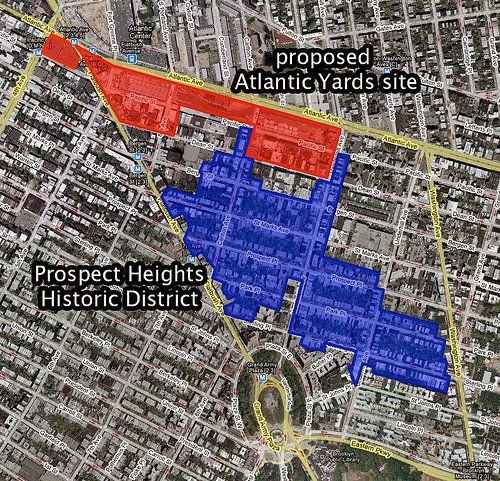
The Atlantic Yards Project, as the Brooklyn Nets arena and complex came to be known as, is a little different than the State taking away private property to directly serve the welfare of the public.  This was a private developer (Ohioan Bruce Ratner) seeking public funds to turn around and develop a section of Brooklyn that currently had housing and businesses within the footprint, in order to serve Brooklynites with an arena, mixed-use commercial and housing (some of it low income).  The only thing missing in this area of Brooklyn prior to the redevelopment was the arena, minus Jay-Z.  But the developer had to prove that the area was blighted to get it condemned.  In the documentary, I found it hard to believe that all 22 acres were blighted, but the film follows the rubber stamping of such recommendations, all the way to the NY Supreme Court.  Eminent domain was a concern of the founders of this country, protecting the citizens with both the 5th and 14th Amendments to the U.S. Constitution, at the very least giving property owners the right to due process and fair compensation.

A newly renovated "blighted" building that needed to be torn down.

The protagonist of the documentary is a single home owner named Daniel Goldstein.  You follow his life as he stands up to the Goliath-like developers and politicians pushing this plan.  You see the struggles and triumphs not only of his opposition efforts, but of his personal life and how his efforts affect his relationships with family and visa versa.

Blighted property directly across the street from designated historical properties?

I don't think I am spoiling the plot by letting out that the Nets did move into their arena and that during the development phase, the economy tanked.  Needless to say, only a very small fraction of the development plans for the 22 acres is built at this time, over ten years after the start of the planning in 2002.  Only recently were there any plans for any of the housing to replace all the units razed in advance of the arena construction.  The developer first blamed the economy and then did the only rational thing in response to the economy, fired the architect (shocker).

Even though the arena was built and the fight was lost, the film is a very captivating look into a very small group of people fought for one of the most American of rights - land ownership.  For six years they struggled against this apparently government sanctioned land grab.  Even though the arena was eventually pushed through, we see the struggle to get due process through the eyes of someone on the ground, whose property literally was center court to the fight.  See the film.  You can decide if the public good outweighed the rights of the property owners who were displaced.

Wednesday, February 19, 2014

Saint Elsewhere


Normally, I read about “green” celebrities with a lot of cynicism.  These people do all they can to make their $400,000 Bentleys get just over 15 miles to the gallon, or install compact fluorescent lights in all five of their 10,000 square foot homes.

I recently read, however, of a friendly competition between the actor Ed Begley Jr. and Bill Nye the Science Guy.  Apparently, Bill moved into Ed’s neighborhood and started to meddle with his new home in order to make it as energy efficient as he could.  Obviously, Bill had some catching up to keep up with the Begley’s.  Ed already powered his house with wind and solar power, composted nearly all of his own waste, and most impressively to me, the Emmy nominated actor does it all in 1,585 square foot home.

Bill has technology on his side, however.  Solar panels, for instance, are far more efficient today than they were 20 or 30 years ago.  As for Ed’s current solar panel, how would you justify throwing his current solar panels into a land fill when the currently produce “free and clean” energy, just not as much as new ones.  Even with such an advantage, it would seem to me that The Science Guy will have to work hard to match the Begley’s measly $300 per year electricity bill.


The fact that Bill and Ed are trying to out do each other in this arena instead of trying to “out-bling” each other was refreshing to me.  Yet it is in California of all places, where even several former governors were movie stars.  And while these two guys are a bit nerdy, maybe, you can count on them to be good, solid, American capitalists.  You can purchase cleaning solution from Ed Begley Jr.’s website and know you are helping to pay for Ed’s electric bill.

Monday, January 27, 2014

Gingerbread 2013 Part Five: Postpartum

Publicity and Dumpsters


From conception to birth, pardon the analogy, it was a journey of about three months.  Starting with our first organizational meeting in September to the Client party in December, to tear down the first weekend of January.  For an ephemeral display, that is a significant amount of time.  The display was officially "open" from December 11, 2013 and was set to be torn down on January 4, 2014 - just over three weeks from completion.  Many who tour the display ask what we do with it once the holidays are over.  Honestly, it is without much guilt that we respond like an umpire at home plate: "It's outta here!"

I imagine it is somewhat like the float builders in Mardi Gras or the Rose Bowl.  Granted this is a simplistic analogy, but we all go into it knowing that the creation will not be permanent.  Or, for the architecture nerds, Aldo Rossi's 1979-1981 Teatro del Mondo, which was built to float across the Adriatic and intended to be dismantled once it reached the other side.  But we still have our piece of Aldo in the china closet in that espresso maker that is too nice to muck up!


We labor on the display knowing full well that its destination will be in the dumpster in a few weeks' time.  But we labor none the less.  As Aldo so poetically put it (I paraphrase here):  the built environment provides a stage for life to occur.  Instead of icing and gingerbread, he used painted plywood and a zinc roof.

But until its demise, mileage, we shall get from it.  Immediately after the Client Party, the local news will come for a live look in on us (starting at 5 AM, lucky for the guy showing up for that!), and a couple of local publications will come to snap a few photos.  We also open it up the next three Thursday evenings to the public.  

And does the public come.  Thank goodness for the new office because we had over 200 people on the fist night, over 300 hundred on the second night and, on the last evening (the day after Christmas) we had almost 450 people.  They waited up to an hour and a half in line.  For some time, some had to wait outside.  We opened the doors to the public at 5 PM right after work and technically they were open until 7 PM (although we didn't turn any latecomers away).  Then it took almost 90 minutes for those last visitors to make it from the front door and out again.  Once a visitor got to the display, it would take between 10 and 15 minutes for those people to get the whole way around.


My apologist comment to the folks coming in was , "I sure hope it was worth the wait."  Most people, either sincere or very good fibbers, seemed to think that it was all worth it.  We used to allow people to come look at it whenever they came by during business hours, but it became so disruptive over the years, that we had to set something up outside the work day.  In three days this year, over 1,200 visitors.  

I think, and I mean this sincerely, that the mobile phone has exasperated the wait times in "modern" times.  People come in with Cellphones, iPhones or iPads and they begin to make a documentary of their visit.  I literally saw people trying to take detailed pictures with a flip phone this year.  And the whole selfie thing is, well, let's just say it held up the line far too much.  I hope someone proves me wrong and we end up in some HBO documentary or something, but I highly doubt it.  No one looks through their own eyes anymore, always filtered through a screen...

After that final public night, it is just a matter of time before we have to dismantle the display.  The first Saturday in January we will typically meet for a few hours, maybe ten or twelve of us.  It really only takes a few hours.  Mostly, there is a lot of banging, tearing and smashing, followed by a lot of vacuuming.  No craft here:


Actually there can be quite a bit of sawing and cutting, just being careful enough not to cut the lights and extension chords woven into the underbelly.  That icing gets really hard.


And just like that there are hundreds of man hours tossed in a cart, being hauled off the the dumpster.  I was able to pluck off several characters I had made out of fondant that will dry rock hard and can be used in the future perhaps.  I saved my kids gingerbread boats (for now).


While it looked pretty cool and might have been able to bust some ghosts, this backpack vacuum wasn't so good at pulling up candy from the carpet.


And this became the final resting place of the 2013 Gingerbread display.  So full the lid wouldn't shut.  In the old office there was a sense of relief to get our much needed table tops back.  This year the display didn't usurp any space that we desperately needed back, but it didn't really dampen our enthusiasm to remove it.  After seventeen of these, at least for me, it is just another stage in the development of the display.  Tear down.  Without it, we can't have another one next year.

Tuesday, January 21, 2014

Gingerbread 2013 Episode IV: Why We Build

The Client Party

Aside from "How do you do this?" one of the most heard questions around the display is "Why do you do this?"  Honestly, it started long before I started at the firm.  I remember visiting it when I was a young student in architecture school in the early 90's.  As I said, we've been doing this gingerbread thing since 1987.  I started in 1997.

It started out as something fun for the guests at our Client Party to look at.  The first couple of years it was a few gingerbread creations set on the table top.  By the time I got to the game, the stakes were raised.  The entire design studio was usurped for the display, there was a complicated voting arrangement, and the display covered more than 100 square feet and used LOTS of candy and icing.


The Client Party is a nice way to say thanks to our Clients and see them in a social setting right before the holidays.  The display itself has become the center piece to the party, we create a fairly in depth ballot for the Clients to vote on their favorite creations.  What do we win, you ask?  Bragging rights, that's what.  It's all for fun.


New office, new twist - we lit up a message on the exterior of our office as seen above.  Have to admit, this was pretty cool.


Above you can see Great Room filling up Clients in the photo above.  We had LOADS more space this year, the previous displays were very tightly woven into the interior of our office layout.  This year's display allowed ample viewing and it never felt overwhelming.  Clients had the opportunity to circle around the display (it was an island) and check their three favorite houses and three favorite accessories.  A motor scooter served as the ballot box.  At the end of the evening, we break open the ballots and start counting.
We had over 200 guests so we probably counted close a thousand votes total.


During the party, staff circulate to greet the Clients.  I have seen, I won't name names, voting persuasion going on during the party.  I think we may begin asking for photo ID for the votes to count next year.  There was both a beer bar and a wine bar, and senior staff took shifts serving the Clients, which is fun.  Below, Scott got into the Italian theme, Sopranos style, while serving a Peroni.


The Client Party dies down about 8 PM.  It was a great turnout this year, as I mentioned.  Some drove several hours on a week night to visit us.  Around this time, the food and beverages are available to the whole staff and it is a chance for us to celebrate finishing the display one more year.  Below you see some of our handsome Architects swapping stories.


Once we eat a bit and drink a bit, we get to counting votes.  We typically recognize the top three vote winners in each of the two categories.  It is competitive, let's just leave it at that.  I've never won first place.  I've place in the top three, but never have won.  You really need to think about why people vote the way they do.  You need a gimmick - something to set you apart.  When I figure it out, I will let you know.

Once we go home on that Wednesday night, we need to start thinking about the publicity that awaits us in the days to come.  We have TV, newspapers and yes, the open house nights for the public to plan.  Those will be described in the next episode.