Reflection

Reflection

Monday, January 27, 2014

Gingerbread 2013 Part Five: Postpartum

Publicity and Dumpsters


From conception to birth, pardon the analogy, it was a journey of about three months.  Starting with our first organizational meeting in September to the Client party in December, to tear down the first weekend of January.  For an ephemeral display, that is a significant amount of time.  The display was officially "open" from December 11, 2013 and was set to be torn down on January 4, 2014 - just over three weeks from completion.  Many who tour the display ask what we do with it once the holidays are over.  Honestly, it is without much guilt that we respond like an umpire at home plate: "It's outta here!"

I imagine it is somewhat like the float builders in Mardi Gras or the Rose Bowl.  Granted this is a simplistic analogy, but we all go into it knowing that the creation will not be permanent.  Or, for the architecture nerds, Aldo Rossi's 1979-1981 Teatro del Mondo, which was built to float across the Adriatic and intended to be dismantled once it reached the other side.  But we still have our piece of Aldo in the china closet in that espresso maker that is too nice to muck up!


We labor on the display knowing full well that its destination will be in the dumpster in a few weeks' time.  But we labor none the less.  As Aldo so poetically put it (I paraphrase here):  the built environment provides a stage for life to occur.  Instead of icing and gingerbread, he used painted plywood and a zinc roof.

But until its demise, mileage, we shall get from it.  Immediately after the Client Party, the local news will come for a live look in on us (starting at 5 AM, lucky for the guy showing up for that!), and a couple of local publications will come to snap a few photos.  We also open it up the next three Thursday evenings to the public.  

And does the public come.  Thank goodness for the new office because we had over 200 people on the fist night, over 300 hundred on the second night and, on the last evening (the day after Christmas) we had almost 450 people.  They waited up to an hour and a half in line.  For some time, some had to wait outside.  We opened the doors to the public at 5 PM right after work and technically they were open until 7 PM (although we didn't turn any latecomers away).  Then it took almost 90 minutes for those last visitors to make it from the front door and out again.  Once a visitor got to the display, it would take between 10 and 15 minutes for those people to get the whole way around.


My apologist comment to the folks coming in was , "I sure hope it was worth the wait."  Most people, either sincere or very good fibbers, seemed to think that it was all worth it.  We used to allow people to come look at it whenever they came by during business hours, but it became so disruptive over the years, that we had to set something up outside the work day.  In three days this year, over 1,200 visitors.  

I think, and I mean this sincerely, that the mobile phone has exasperated the wait times in "modern" times.  People come in with Cellphones, iPhones or iPads and they begin to make a documentary of their visit.  I literally saw people trying to take detailed pictures with a flip phone this year.  And the whole selfie thing is, well, let's just say it held up the line far too much.  I hope someone proves me wrong and we end up in some HBO documentary or something, but I highly doubt it.  No one looks through their own eyes anymore, always filtered through a screen...

After that final public night, it is just a matter of time before we have to dismantle the display.  The first Saturday in January we will typically meet for a few hours, maybe ten or twelve of us.  It really only takes a few hours.  Mostly, there is a lot of banging, tearing and smashing, followed by a lot of vacuuming.  No craft here:


Actually there can be quite a bit of sawing and cutting, just being careful enough not to cut the lights and extension chords woven into the underbelly.  That icing gets really hard.


And just like that there are hundreds of man hours tossed in a cart, being hauled off the the dumpster.  I was able to pluck off several characters I had made out of fondant that will dry rock hard and can be used in the future perhaps.  I saved my kids gingerbread boats (for now).


While it looked pretty cool and might have been able to bust some ghosts, this backpack vacuum wasn't so good at pulling up candy from the carpet.


And this became the final resting place of the 2013 Gingerbread display.  So full the lid wouldn't shut.  In the old office there was a sense of relief to get our much needed table tops back.  This year the display didn't usurp any space that we desperately needed back, but it didn't really dampen our enthusiasm to remove it.  After seventeen of these, at least for me, it is just another stage in the development of the display.  Tear down.  Without it, we can't have another one next year.

Tuesday, January 21, 2014

Gingerbread 2013 Episode IV: Why We Build

The Client Party

Aside from "How do you do this?" one of the most heard questions around the display is "Why do you do this?"  Honestly, it started long before I started at the firm.  I remember visiting it when I was a young student in architecture school in the early 90's.  As I said, we've been doing this gingerbread thing since 1987.  I started in 1997.

It started out as something fun for the guests at our Client Party to look at.  The first couple of years it was a few gingerbread creations set on the table top.  By the time I got to the game, the stakes were raised.  The entire design studio was usurped for the display, there was a complicated voting arrangement, and the display covered more than 100 square feet and used LOTS of candy and icing.


The Client Party is a nice way to say thanks to our Clients and see them in a social setting right before the holidays.  The display itself has become the center piece to the party, we create a fairly in depth ballot for the Clients to vote on their favorite creations.  What do we win, you ask?  Bragging rights, that's what.  It's all for fun.


New office, new twist - we lit up a message on the exterior of our office as seen above.  Have to admit, this was pretty cool.


Above you can see Great Room filling up Clients in the photo above.  We had LOADS more space this year, the previous displays were very tightly woven into the interior of our office layout.  This year's display allowed ample viewing and it never felt overwhelming.  Clients had the opportunity to circle around the display (it was an island) and check their three favorite houses and three favorite accessories.  A motor scooter served as the ballot box.  At the end of the evening, we break open the ballots and start counting.
We had over 200 guests so we probably counted close a thousand votes total.


During the party, staff circulate to greet the Clients.  I have seen, I won't name names, voting persuasion going on during the party.  I think we may begin asking for photo ID for the votes to count next year.  There was both a beer bar and a wine bar, and senior staff took shifts serving the Clients, which is fun.  Below, Scott got into the Italian theme, Sopranos style, while serving a Peroni.

The Client Party dies down about 8 PM.  It was a great turnout this year, as I mentioned.  Some drove several hours on a week night to visit us.  Around this time, the food and beverages are available to the whole staff and it is a chance for us to celebrate finishing the display one more year.  Below you see some of our handsome Architects swapping stories.


Once we eat a bit and drink a bit, we get to counting votes.  We typically recognize the top three vote winners in each of the two categories.  It is competitive, let's just leave it at that.  I've never won first place.  I've place in the top three, but never have won.  You really need to think about why people vote the way they do.  You need a gimmick - something to set you apart.  When I figure it out, I will let you know.

Once we go home on that Wednesday night, we need to start thinking about the publicity that awaits us in the days to come.  We have TV, newspapers and yes, the open house nights for the public to plan.  Those will be described in the next episode.


Friday, January 17, 2014

Gingerbread 2013: Part Three

Why Do We Do This Every Year, Again?


Every year, there is a week long push to really get the display to come together.  Basically, groups of people start staying late in the evenings after work and all day on Saturday and Sunday.  (See football game on the wall in the background).  Usually, Monday and Tuesday are more or less touch-up and clean up.  The last couple days are when you see the opportunity for a few of the funny accessories.  They kind of happen once you see how everything lays out.


At a certain point, we need to start mass producing the little things that enliven the display.  This happens once most of the people are done with their houses.  People and animals make the scenes come to life.  Bikes, cars, trees and carts fill in the gaps.  In the photo above, there are tons of little things created to go "somewhere".  Birds come together with some Good & Plenty's and gum, Rabbits and dogs come from a bit of colored fondant.  Some things we kind of know where we want them to go, others are just for fill in.


The centerpiece of the display was a monastery.  So i figured it should have some monks.  Since they wear cloaks, they weren't too hard.  For some reason, I felt they should all have male patterned baldness, maybe a reflection of the maker?  And who else was in the news?


The Pope, of course.  This was Italy anyway.  And he was coincidentally named Time's person of the year about a week later.  His hat is a rigatoni.  He is in a Volkswagen, because I mistakenly thought lost so people would have heard this same joke I had.  Q:  "How do you fit the Pope in a Volkswagen?"  A:  "You take off his hat."  Well, I gave him a convertible, and I was really dead wrong about others having heard the joke.  NO ONE heard it before.

Eventually we get close to done.  We hung clouds, which looked great and were back lit.  Someone had the idea to make a moon, which led to someone making an astronaut standing on the moon, and someone gave the astronaut an RLPS flag, then I had the idea to make a man looking through a macaroni telescope on a rooftop.

There he is on that pink octagonal building.  There's even a bit of meaning behind that octagon, as it is one of RLPS' trademark visual elements we like to use in our projects.

All told we used 60 sheets of gingerbread, 30 gallons of icing, 80 pounds of candy. pasta, cereal and crackers.  All of this stuff had arrived only two weeks prior.  And it all leads up to the Client party on Wednesday night.  Oh yeah, that party is the entire reason we do this every year.  That is how it started and who we actually do it for.  I've been around for 17 of the 25 years it's been done.  My next post will finally address the finished results.  Tune in next time!

Sunday, January 5, 2014

Gingerbread 2013: Part Two

Background Creation

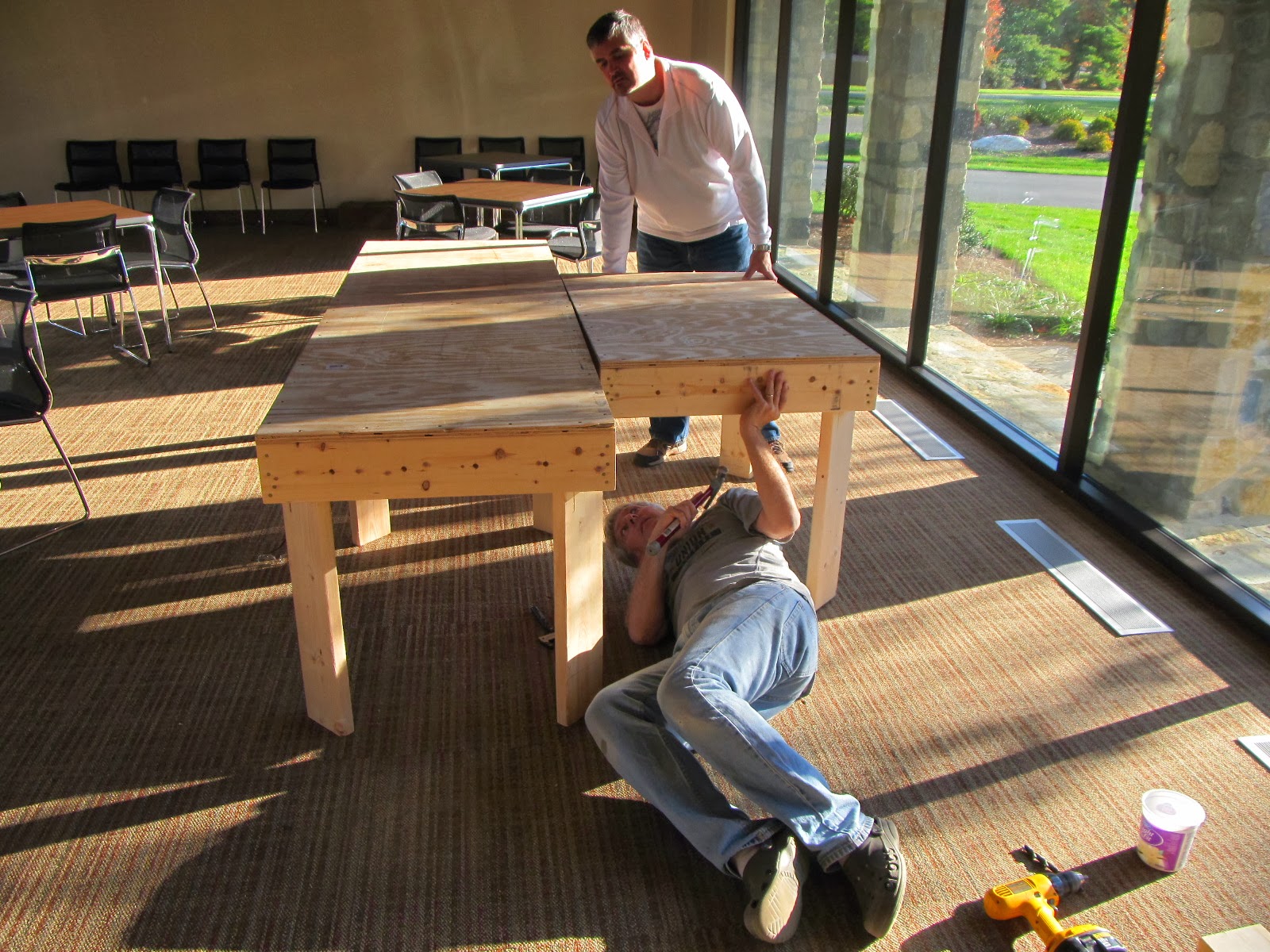
 This year, in our new office the construction of the base was a bit different in that we had to start from scratch.  In our former office, we had two layout tables that served as the foundation of the base with some 2x6's spanning over top.  This year, Eric created a modular system of plywood covered tables that can be bolted together.  He built them all in his basement and they were assembled in the Great Room.
In usual fashion, we covered the plywood base with 2 inch rigid insulation to create the required topography of the island.  The entire perimeter would become the water's edge. The insulation eventually gets covered with icing or some other edible surface.
Since this display was to be a true island, a small trap door was devised to allow access to the very center so that people did not have to be suspended from the rafters, Mission Impossible style.  The trap door would eventually get covered, and a little insulation manhole cover was devised.  I am not sure why it kept getting set in place, because it kept getting stepped on.  I won't name any names, but the guy who wrote "This is really not a step" was the second guy to step through the manhole cover.
Above is the second of three successive manhole covers to top the trap door.  And below is what happens when a full sized man steps on it...
Along with all the base preparations come the background buildings.  These are typically done by the display group and many hands touch them in one way or another.  This year was to be a monastery and I worked on the cloister piece in the photo below.  I got some loose sketches from Brent the designer based on a photograph of a real monastery.  Then, much as in my real job, I have to take these sketches and make them work in real life.  This foam base will eventually be iced and covered in crushed peanuts.  The monastery structure was probably one of the best background buildings ever built, in my opinion.  And the scent of peanuts was so strong, we started to wonder if the scent alone could trigger anaphylactic shock in someone seriously allergic, that we put up a warning at the front door.
Ordinarily there is a subset of the group who has the reigns of the overall design concept for the background buildings.  We count on them to give enough direction to us worker bees to pump out the items that become the background.
One week before the Client Party, we have Family Night.  After work all the families that care to can come into the office and work on the various parts of the display, mostly the individual houses, but some of the group continue to work on the background.  Prior to the event, the entire floor was covered in the plastic sticky stuff you see in new houses or in renovations.  A lot of the houses are worked on by entire families, including spouses and children.  Other teams are composed of multiple staff members.  They are big undertakings, so the extra help is always worth it.  The office will order a dozen or two pizzas typically.

The week between Family night sees probably the most significant amount of work on the display during that time.  It is a bit ironic because after family night, our spouses don't see much of us until a week later.  My kids (8 and 10 at the time) LOVE helping, so they spend a lot of time with me after school and during the intermittent weekend helping out.  At this stage, they can actually contribute to the display on their own without my supervision and I can continue to work on what I need to work on.  Aside from one minor Xacto cut and several hot glue gun burns, they were fine.

The next post will address the final week and all the little details that really make the display shine.


Saturday, December 28, 2013

Gingerbread 2013: Part One

Part One:  Concept

Our gingerbread display here at RLPS is legend.  I can say that because it has been going on for twenty-five years, annually since 1987.  Those of you quick in math may point out that this is a twenty-six year span. You'd be right.  But we did not do a display in 2001, following the 9/11 attacks, the aftereffects of which had already been felt heavily on us and our Clients.  The decision was made to abstain that year.

That said, the gingerbread display originated as a fun activity for our Clients at our annual Christmas party, held at the beginning of each December on a Wednesday night.  Quickly, it snowballed into a larger than life display, garnering local news coverage and we eventually intuited public viewing options after hours because allowing the public in throughout the day became so disruptive, it was hard to get through our old design studio.  Busloads (literally) would show up in the middle of the day.

I say "old" design studio meaning we've moved our office in the last 12 months.  So this is our first display ever in our new digs.  As you might imagine, there was a good amount of thought as to where the display would go, and how people would get to it.  I must say, with a few exceptions (I will get to those later) the display went off very well.  The exceptions had nothing to do with the building design, but how the display was set up for circulation.

One of the questions we hear all the time is, "How do you come up with the ideas, year to year?"  This year, i tried to document this part of the process, as the actual making of the display and the finished product garner a lot of attention and photographs, this part is a little less exciting, but nonetheless an important part of the story.  Each year, we begin with some committee meetings and someone (usually a newer hire) is tapped to be the main organizer.  This is our kind of hazing; much more cruel than any other I've ever heard about even in the recent NFL allegations in Miami.  This person has to herd in dozens of people, organize volunteer work sessions, make sure food is there for the volunteers (ultimately important) and keep the schedule.

We start thinking about the theme in early Fall.  This year, a theme that has been knocking around for a few years became the predetermined theme.  This is unusual for us, as normally, the first meeting of the Committee is brainstorming ideas and coming up with a short list of ideas that are ultimately voted upon.  This year the underlying idea and even a concept plan was presented to the Committee on September 25, 2013 at a lunchtime meeting.  We had pizza for lunch...


Some planning went into the presentation ahead of time:


...and the idea was presented to the Committee.  Already ideas were in place as to how the houses would be placed on the site and in relation to the other houses:


Scale of the houses had to be decided.  3/8" = 1'-0" works well for us so the buildings aren't too big, nor are people in the setting too small to build.

This year we had three formal meetings.  The next meeting was about two weeks later.  This year, as we were in a new space, we had to build an entirely new base for the display.  We had used a pair of layout counters in the old office.  This year we were placing the display in a larger room with no fixed furnishing to work around. 


This allowed us to lower the display and there was no real constraint on front versus back.  As the them was to be an Italian hill town, we noodled on how best to represent this concept.  Speaking of noodles:


Noodles would take a prominent role in this display.

The last formal meeting took place in the first week of November.  We ate subs.  I will pick up the story in the next posting...

Saturday, November 30, 2013

Wrestling with Sanity


I am not sure when people actually go crazy. I am pretty sure one clue is when you think you know everything about everything. I hope that I remain aware enough to know that I will never know it all. Recently I heard a radio interview with Former Governor (and wresting star) Jesse Ventura about his take on the World Trade Center Tower failures. I am not sure if he spent too much time under water in the Navy, was dropped on his head too many times in the ring or spent too much time around people in Minnesota who can not pronounce their O’s correctly, but he is a lunatic. 

The Body is convinced that there was some sort of conspiracy involving the owners of the buildings to “get rid of them”. He also believes there was some sort of controlled demolition in Building 7. I didn't catch the whole interview, and perhaps some of what I am reacting to in somewhat out of context, but….WHAT??? His argument was that these buildings were designed to withstand the impact of a Boeing 707 and should not have collapsed as they did. Okay. Let me reach for my U.L. rating book and find that wall design. Hmmm. Okay, there are no airplane proof assemblies listed - how about a column rating test that will withstand the heat of thousands of gallons of jet fuel combusting virtually instantaneously? Hmmm. I am guessing that the temperature inside the buildings at impact of the planes exceeded 1000 degrees after 15 minutes and 2000 degrees after 240 minutes and that would exceed the ANSI guidelines for testing fire resistance of an assembly. That test also does not account for tons of debris ripping off the fireproof covering and devastating the structural system without the aid of any heat. Each tower stood for over an hour after impact. That in itself amazes me to this day. How anyone expected more, I do not know. 

I am no forensic engineer by any stretch of the imagination. I don’t know everything. In fact, I know that I know very little about that science even though I do know a bit about buildings. But I do know to keep some of the crazy thoughts that go on inside my head right where they are. No need to share. Some people need their windmills to chase, I guess. 

As MIT professor Noam Chomsky recently quipped about this very subject, "There happened to be a lot of people around who spend an hour on the internet and think they know a lot about physics, but it doesn't work like that." If it did work like that, I'd have a PhD in Caddyshack quotes or whatever else I've invested an hour into lately on the internet.

Sunday, November 10, 2013

Fixing the Flux Capacitor


It’s difficult to convey to a Client that a set of documents representing their new building or renovation is a delicate ecosystem.  The plans live in a subtle balance of structural framing and mechanical systems, not to mention the life safety components such as egress and fire protection.  Just as in nature, if one facet of the ecosystem is altered, it can very quickly affect all of the other systems within that environment.  


Or a more colorful comparison that comes to my mind is that changing a design once too many decisions have already been made is a bit like time travel.  Depending on which theory one buys into; whether there are parallel cosmic timelines (alternate universes) versus loops in spacetime, there may be some arguments to the finer points.  Let’s just say we subscribe to the concept that history is plastic and subject to change, and that changes to history, while seemingly insignificant, can impact the time traveler, the entire world, or both.


Imagine a Client wants to change the environment we are creating for them.  They want to change the door locations, move walls, combine spaces.  That’s fine, of course.  It is also what the design development or schematics phases are for, but I digress.  Moving doors can affect egress paths.  Moving walls can affect sprinkler layouts.  Combining spaces may affect occupancy loads.  And each of these first layer changes can require additional changes to other systems, and on and on and so forth and so on.  In time travel this is called ‘resulting paradoxes’.  In building design this is called ‘additional services due to design revisions’.  Either way, you have to pay for the changes you incur.


The easiest illustration of this concept is the Back to the Future trilogy.  There are others like Doctor Who or stories by those like Ray Bradbury, but I am most familiar with the beloved science fiction comedy from 1985.  In the film, Michael J. Fox’s character, Marty McFly, ends up in a point in time where he is presented with his parents as teenagers before they had began dating.  Any move Michael J. Fox makes seems to change the exact sequences of actions from the way they happened the first time, creating a significant ripple effect that changes time and impacting the future.  Simply the fact that Marty exists in the point in time is enough to make some changes.  Think about how the girl who becomes Marty’s mother (Lea Thompson’s character) is attracted to him instead of his father George while they are both teenagers.  Creepy enough for you?  But this fact alone creates a paradox that can bring Marty’s world to a sticky end.  If Marty changes the series of events that results in his teenage mother and father getting together at the perfect moment, Marty ceases to exist!


Just as Marty needs to repair the damages he created to his parents love story throughout the rest of the movie, the Architect must repair all the ‘damages’ generated by the Client altering the delicate universe we have created.  The ripple effect is often not immediately visible.  Often, additional necessary changes are uncovered as you work your way through the first set of changes, and each consultant that needs to react may discover supplementary revisions they need to sort out which again affects the architecture in a seemingly endless loop.  All this work is an effort to get back to a world where everything is okay again (Marty’s version of 1985).

Ultimately it is the Architect’s job to keep the Client happy, and this will include allowing them to change their mind even when it is late in the process.  We as the design professionals, however, are obligated to inform the Client of the ramifications and help them understand that some changes become a vehicle to additional services. And while these are never is as cool as Marty’s time traveling vehicle, the DeLorean DMC-12, we must not create immovable roadblocks because of the changes.  Because unlike the film, ‘Where we’re going, we DO need roads!”  We just need to fix the flux capacitor and get back to 1985.