
One
of our firm’s primary concentrations is on Senior Housing. A growing trend in CCRC’s (Continuing Care
Retirement Communities) is to provide dedicated memory support units for
personal care or skilled nursing. In
fact, one of the first buildings I worked on at RLPS during my internship was a
new building that contained both under one roof, just a few miles from our
office. Coincidentally, my grandmother
wound up living there for several years.
You can imagine, through all my visits with her, by me alone or with my
family, my eye did not stop looking at her surroundings critically. Whether a room was too small, a ceiling was a
little low or a paint color questioned, I continued to critique our work.
Having
a frail relative live in one of the spaces you’ve helped create changes how you
look at the building. It quickly changes
from “how does this detail work for the resident” to “how does this detail work
for grandma?” In a surreal course of events, I have now had three family members enter senior housing facilities I was
directly involved with the design. My grandfather spent his last seven days in a Hospice facility we designed, my
grandmother spent time in both rehab and memory care in another building that I
served as project architect. Even today as I type, my mother-in-law is receiving treatment at a rehab
facility due to a stroke. I can look on a room size or detail and recall
the now invisible signs of compromise. I
can literally see through the walls or ceilings and observe the duct crossings
under structural members that produce a less than ideal ceiling height. Was there anything I could have done differently? Perhaps.
Perhaps not.
But
even as I walk through the building with a family member who is now the "resident",
there is another personal experience that can help affect design for those
dealing with dementia and memory loss.
About a year ago, our office provided some educational training that some
may think unusual for a designer in which to participate. A non-profit organization called Second Wind
Dreams has a Virtual Dementia Tour program that helps people who care those
dealing with dementia feel the symptoms of dementia first hand. Most of the designers in our office
participated in the program which was held, coincidentally, in one of the same
building one of my grandparents had lived.
So it had even more emotional impact on me I think.
The
program is fairly simple. The
course-taker is given some of the symptoms of a dementia resident would have
and must navigate a typical resident room and complete several everyday
tasks. Easy, right? Stay tuned.
The
course-taker first places inserts in their shoes that gives the fell of pins
and needles on the bottom of the feet.
This affects your mobility and provides a nagging discomfort with which
you need to overcome.
Then,
you have gloves to wear that both desensitize your sense of touch and impair
your dexterity.
Next,
you get a set of headphones to wear. And
while you hope for some Pink Floyd, what you hear is cars honking, static like when
tuning a radio, voices, and other confusing noises - picture walking through a
haunted fun house.
And
lastly, some cool goggles. Instead of a
rose colored lens, the world is flushed with a yellow fog and I think they were
even more provided with some other vision impairing characterizes, but alas, I had
to remove my own glasses in order to fit the goggles on my head, so my eyes
were at an even harsher disadvantage.
Once
outfitted with our gear, the provider gave us several tasks to perform in the
room. The ability to hear was impacted
so I am sure I asked a little too loudly for them to repeat the list for me. Inside the room, we had to first find the articles
we were told to use in the tasks. It was
really hard for me to see, and some level of reading and/or writing was
required. I also had to see colors to
find a book and move it, and to find a certain sweater and fold it. I truly felt that there was not enough light
in the room, so I kept carrying things to the open window so I could see the
task item. I didn’t even think to look
for light switches to turn them on.
 |
| An obstacle course, or rather, a skilled care corridor. Try this with the goggles. |
The tingling in the feet was a bit distracting, but the headphones really were. Several times very loud noises came from nowhere and startled you. Plus, I am pretty sure I didn’t hear any of the tasks 100% accurately. I believe I was looking for a green sweater that didn’t exist where I was supposed to be looking for a pink one. The gloves on our hands made it difficult to sort through laundry, separate plates and bowls, and to write on paper.
While this program is probably geared toward caregivers and family members of those facing the challenges of dementia, as designers, we really found ourselves learning how difficult it is to navigate through a room we designed.

While this program is probably geared toward caregivers and family members of those facing the challenges of dementia, as designers, we really found ourselves learning how difficult it is to navigate through a room we designed.
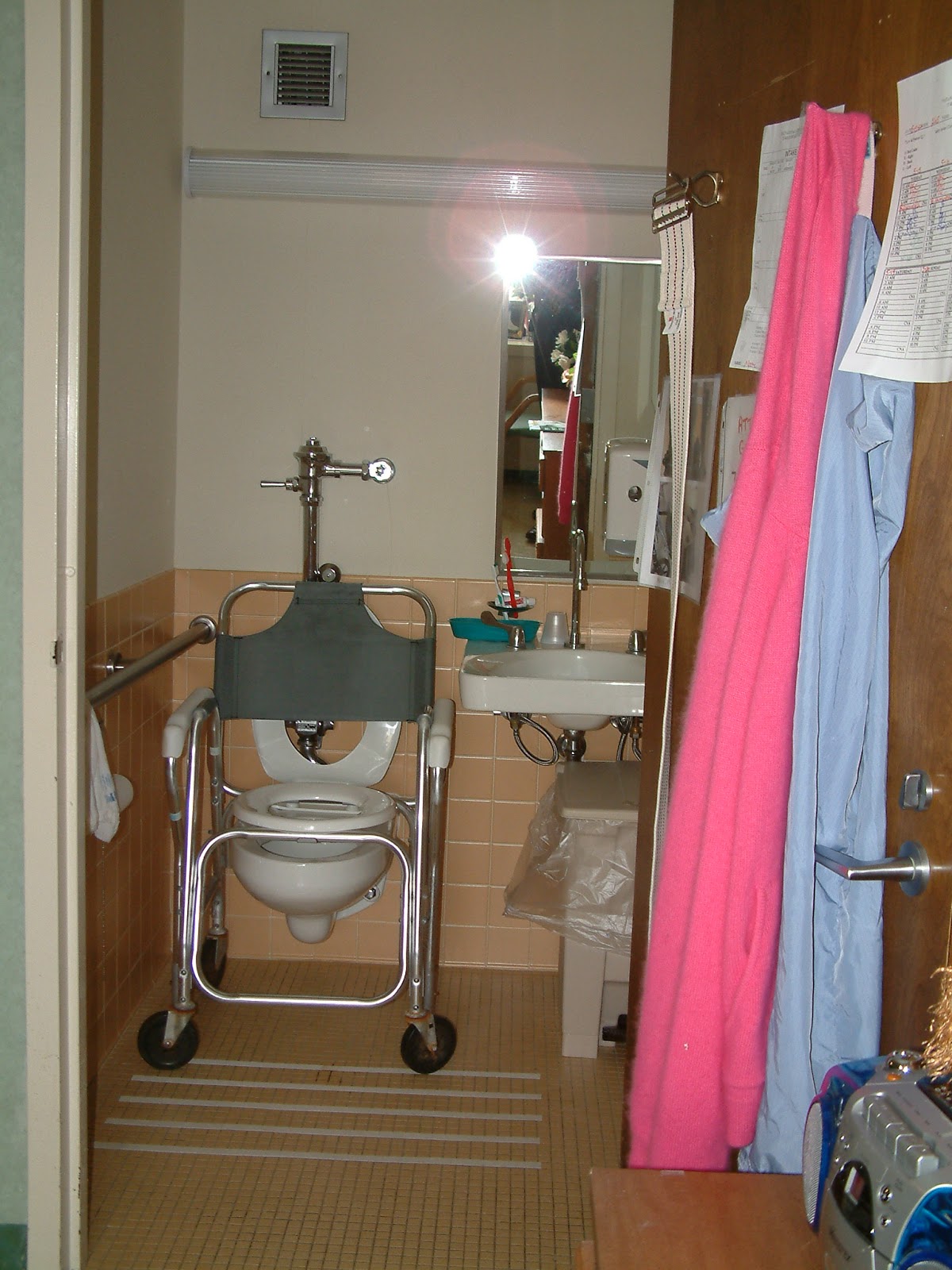
 |
| I don't care who you are, trying to figure out where to go in these bathrooms is a challenge. |
Lighting
is important. We had all heard that too
much light is not good for dementia units and we need to tone down light levels
and glare so residents are not upset, but ordinary tasks in dark rooms are not
possible.
 |
| A bad example of glare at the end of a corridor. Clean floors, but... |
Cueing
is crucial. I didn’t think to turn on
the lights because the switches were not easily seen. The same importance can be laid on toilet fixture
locations and where clothing to wear the next day is placed.
 |
| A standard method of room cueing - memory boxes with personal items of the residents. |
Patience
is essential. It takes ten times longer
to do any task in this state. I needed to
hear the directions multiple times, and loudly.
But
I can do the tasks myself. I may need
assistance, but need to do it myself.
For more information on the Virtual Dementia Tour, see Second Wind Dreams
For more information on the Virtual Dementia Tour, see Second Wind Dreams

