Reflection

Reflection

Wednesday, July 30, 2014

The Cardboard Portal


In third year of college, our class was given the task of recreating the Laurentian Library portal, designed by Michelangelo, in corrugated cardboard.  For about a month we stole boxes from dumpsters of all the local businesses in the area under cover of darkness.  Looking back, that wasn't really responsible of the professors, assigning us petty larceny.  However, we did and just stacked an entire corridor full of the broken down boxes, like five feet high.  Another good example of careless instruction from professors – go store hundreds of pounds of combustible materials in this egress component. But Frank Gehry was making furniture out of cardboard at the time so it had to be okay.

The construction was a huge task and we were given just a weekend to complete it.  Friday afternoon we began by laminating layers of boxes with wood glue and creating templates.  Once our building blocks had dried, we cut them in the model shop on band saws and table saws.  There was so much to do (the thing was full scale and ended up being sixteen feet tall) that we started off scheduling four hours of sleep per person per day.  That sleep quickly evaporated as the work consumed us.

People were half dead by Sunday, using power tools on University property on a class assignment.  We were lucky no one lost a finger or worse.  I carry a scar on my forearm from that weekend as a result of a run in with a hot glue gun.  The end result was utterly amazing when I think about it.  About thirty kids accomplished quite a feat in a single weekend.  None of my friends in other majors could believe the kind of boot camp us architecture students went through.  On the weekends, they had fraternity parties and bar hopping.  I think it may have even been Homecoming Weekend.  Meanwhile, we were fabricating full scale buildings out of refrigerator boxes.  The only regret I have is that it was almost impossible to photograph due to the location we were instructed to install it.


For some reason, the classes after ours did not participate in such a cardboard charette.  There was never any formal explanation, but my assumption is that some faculty member gave a second thought to the liability.

Monday, July 14, 2014

The Poor-trayal

It is some sort of conspiracy.  I blame the media.  This job, the profession I've chosen, has a serious public relations problem.

Again, some guy wrote an overly complicated law, fessed up and said it was intended to fool us, and instead of calling him an ECONOMIST or a POLITICIAN, they called him (what?) an ARCHITECT.  Why, why, why???

So Called Obamacare Architect:  Jonathan Gruber


You cannot, by PA State law, call yourself an architect if you do not meet a certain set of predetermined requirements.  This is a good thing as the main responsibility of an architect is to defend the health, safety and welfare of those that are served.  So why is it that anytime someone gets their hand caught in the cookie jar, the press renames the scoundrel “the architect of greed”.  You remember Enron, don’t you?  Or do you remember them simply as “the architects of fraud”?  Or Adolf Eichmann, who is often referred to as the “architect of the Holocaust”?  Even Adolf Hitler’s real architect, Albert Speer, went to jail for twenty years charged with war crimes.  Where the heck are the architects of good things?  Where is my Mahatma Gandhi, the “architect of peace”?  At this point I am looking for anything; Mother Theresa, “the architect of empathy”?
The Quintessential Image of the Architect


It doesn't stop there, of course.  It bleeds into popular literature and film.  Most architects are portrayed as fiercely egocentric figures, like Howard Roark (The Fountainhead) and Stanley Kracklite (The Belly of an Architect).  If architects are not portrayed as tragically self-absorbed characters, they are shown to be buffoons.  Certainly some sitcom writer dropped out of architecture school after about six weeks, went into writing and made some real money.  Early on in the television rendition of Dagwood Bumstead in Blondie, Dagwood is a bumbling architect, working for the overbearing J.C. Dithers.  Move to more recent presentations in According to Jim, Jim Belushi (a contractor) rides roughshod over his brother-in-law, Andy (the inept architect).  Think about syrupy sweet Mike Brady (The Brady Bunch), desperate romantic Ted (How I Met Your Mother), or sorry Woody Harrelson as David Murphy, who couldn't keep Robert Redford’s character from scoring on his wife in Indecent Proposal.  Even the forlorn yet lovable character from “Sleepless in Seattle” (Tom Hanks) gets outsmarted by his nine year old son multiple times throughout the movie (and he lives on a boat).


Sappy Tom Hanks Architect


With every rule, however, there are exceptions.  For some reason, those in the information technology industry have taken to the term of “architecture” as the series of complex systems that runs their digital landscape.  I get this from one point of view, but they should really have their own title.  This concept of architect as creator was complete, when Bill Gates donned the title of Chief Software Architect.  It must be like a Medical Physician when he or she sees "Dr. Rooter, The Plumber" advertised on TV.  To me, it is a little unnerving.  I think of when Neo of the Matrix movies meet his landscape’s creator, The Architect (as he is known) explains away his lack of compassion by simply stating, “What do you think I am – Human?”

The Architect who Messes with Neo


As a postscript, another alarming fact is that all of the characters mentioned above, real or otherwise, are exclusively Caucasian and male.  This shall provide fodder for a future lesson learned.  One notable exception is Wesley Snipe’s character in “Jungle Fever”.

Wednesday, June 4, 2014

Lasagna Battery


Sometimes, very complicated and technical rules may boggle the mind, but sometimes they can be demonstrated very easily in the average person’s kitchen.  One such “experiment” demonstrates galvanic corrosion, which is the reaction certain metals exhibit when they make contact with each other in the presence of an electrolyte.  More simply stated; when metals get rained on and overlap each other.  This rather tedious sounding process can be explained in a very tasty way, in fact.  

The demonstration is commonly known as the lasagna battery.  Try cooking a delicious (and salty) lasagna in a steel baking pan, then cover it with aluminum foil.  In a few hours, you will see small holes developing in the foil where it is in contact with the food.  You will also see spots on the food where the aluminum has apparently dissolved. The two metals are placed into an electrolyte (lasagna).  Since the aluminum is lower on the electrochemical series, or less noble than the steel, the foil actually ionizes due to a rapid chemical reaction charged by a small electrical current.  This is why you have to be careful when you have one metal on a roof or wall in contact with a different metal composition in the presences of an electrolyte (rain water is enough).  Value Engineering metals can be hazardous to a roof's health!


But don't feel bad.  Even Gustav Eiffel got it wrong.  Over time, the shellac between the copper skin of our Statue of Liberty failed over time, allowing the iron pins to come into contact with the more noble copper.  Maybe old Gustav knew this would happen over time and, as the relations between the two nations cooled, Lady Liberty began to disrobe.  Our government fixed the problem, replacing the shellac with Teflon, properly insulating the two metals.


Wednesday, May 28, 2014

The Price of a Hot Dog


My first full-time job in the field was two minutes away from the George Washington Bridge and New York City.  The latter half of the 1990’s saw tremendous growth in our industry and I quickly began to see my friends jump from firm to firm, unassumingly to advance their career.  This was particularly true in Manhattan where there are more architects than panhandlers, at least in the post-Giuliani era.

My job at the Japanese company was okay, but actually the Japanese economy was hitting a financial correction.  As a result, the work for Japanese automakers, finance companies and manufacturing plants in the U.S. was slowing.  So I was a little wary, although I was not actively pursuing any other potential employment at the time.

Then one day I got a phone call and an invitation to lunch from Gregg Scott.  I had spent the previous summer as an intern at RLPS and worked a lot on models and renderings for his projects.  So of course I was interested in hearing what he had to say.  So I showed up to his house on a Saturday in the autumn of 1996.  I am not sure what I expected for lunch, but what I found was a lunch of hot dogs and potato salad on his patio.

I was not expecting a lavish lunch, but I could not have been more convinced that I would be hitching my wagon to a down right, down to earth organization.  I don’t know if Gregg saw something in me and intentionally made that selection, or if he just liked hot dogs, or if I was only worth the price of a hot dog, but irrespective of the reasoning, it worked.


That lunch had an effect on the next 6,000 lunches I have eaten, because for the next 17 years (and counting), I gave up the more cosmopolitan dishes from New York in favor of the brown bag style I had grown up knowing.  That was just fine with me, because I was tired of unagi (that’s eel in Japanese in case you don't frequent sushi shops).


Wednesday, April 30, 2014

Walk the Walk

Walk the Walk

Have you ever tried to cancel something that comes to you for free?  It seems to me that the less effort it takes for something to show up to your door step, the harder it is to get rid of it.  Whether it be leaflets left on your car, unwanted solicitation telephone calls or junk mail, it is darn near as impossible to stop these things as it is the rain.

This article has nothing to do with the building industry, except that it has a lot to do with it.  I recently decided I should stop my subscription to the Architectural Record, a magazine that comes to my doorstep every month accompanied by a lot of other junk mail tied to the fact that my name is on their mailing list, I presume.  This magazine comes to me as benefit due to my membership in the AIA.  The office always has at least one copy of this magazine in the library, and 9 times out of 10, I look through it in the office rather than at my home.  My magazine at home goes unread and is thrown out, so it makes perfect sense to try and stop the waste.

I called the publisher to cancel my subscription, and they referred me back to the AIA, as they “handle” these issues with AIA members.  The nice lady at the AIA informed me that I could not, by any means, stop my subscription.  I was dumbfounded.  I had the sense at the last second to ask for someone’s contact information to complain about this situation.  The woman I spoke to on the phone indicated that in her twelve years, she has received this request too many times to count. 

My email to the AIA membership director was responded to within three hours.  The explanation I received was unacceptable to me.  As I guessed, she told me that there was a contractual obligation between the AIA and the publisher for us to receive this magazine.  Even though there is a digital version of the magazine, it was noted that to receive this, there would be an “added expense to AIA members”.  With that, the email ended, except that in her digital signature and title, was an AIA logo that included the words “Walk the walk, architects leading the sustainable evolution” with a green boot print next to it.

I was furious at the duplicity, and yet extremely amused by the irony.  I responded to the woman, and thanked her very much for her response, although I did not agree with her that the AIA was  working hard to help the environment based on this agreement founded on ad revenues and inflated circulation numbers for the publisher.  I copied the logo with the green footprint and pasted it into the body of my text and threw the question back to her – “How about walking the walk?”, I suggested.  I then asked her if it was possible for me to change my subscription delivery address to 1735 New York Avenue, N.W. in Washington, D.C. – the national office of the AIA.  Strangely, I haven't heard back from her.  I wonder if anyone has since changed their mailing address.

I am half afraid, as soon as this post goes public, that Wilfred Brimley will show up and give me a talking to like he did to Kramer in Seinfeld.  I swear, I am not trying to stop all the mail!


Friday, March 7, 2014

99 Problems - How a Basketball Team Evicted Hundreds of Property Owners Through Eminent Domain

Eminent domain is the power of the government to take private property for the use of the public, following just compensation.  It has been a hot topic in years past.  I fell upon a documentary film on TV recently describing the battle over 22 acres of low-rise residential and light commercial privately owned real estate in order to bring the New Jersey Nets stadium to Brooklyn, called Battle for Brooklyn.  The film follows the residents and local groups who began a grass roots organization called Develop Don't Destroy Brooklyn to fight the development, led by a corporation from Ohio and star architect, Frank Gehry.  And if Gehry isn't enough star power for you, Jay-Z and Beyonce flit in an out of the story line, and of course become part owners of the Nets.

 Protesters Demanding Jobs Previously Promised.

An Artist's Rendering of the Developer.

The concept of eminent domain is not new.  In Biblical terms, King Ahab of Samaria is said to have paid Naboth for the taking of his vineyard.  Quite frankly eminent domain will often benefit architects, as it typically turns into large building projects.  For instance, Pope Julius II was a remarkable patron of the arts and architecture, and transformed Rome from a network of medieval neighborhoods into the Eternal City of the Renaissance that we know today.  Subsequent leaders up to and including Mussolini expanded on creating these broad avenues that connect major focal points of religious and secular importance, which were once residential living quarters of the common Roman.

Napoleon III commissioned Haussmann's Plan for Paris in the mid-1800's, restructuring the boulevards and creating new public parks and regulating the facades of buildings along the major axis.  While this plan created the organization of Paris that not only reformed Parisian life, but it also influenced urban design around the world for centuries.  During the reorganization, however, the new paths of public domain cut through the dense medieval context like a hot knife through a croissant, displacing its residents.

 The Medieval City of Paris
A small part of the Haussmann Plan

Both of these plans were backed by the State.  In many cases the plans were executed by private developers propped up by loans from the government (otherwise known tax payer money).  And while I don't have the records of whether the former inhabitants were paid fairly, my guess is there was little room for negotiation in 1500's Rome or 1850's France.  The legacy of these plans is undeniable, however.  Who can imaging Rome or Paris without the organization it has as a result of Julius II or Napoleon III?  Not until the times of Corbusier did we see reactions to this type of urban planning, where of course Corbu proposed bulldozing most of central Paris in favor of his idea for an urban center.

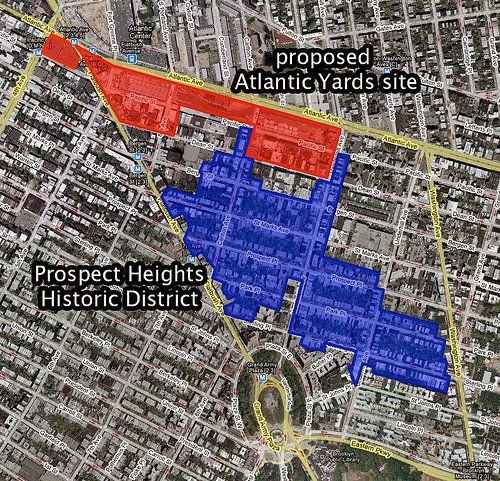
The Atlantic Yards Project, as the Brooklyn Nets arena and complex came to be known as, is a little different than the State taking away private property to directly serve the welfare of the public.  This was a private developer (Ohioan Bruce Ratner) seeking public funds to turn around and develop a section of Brooklyn that currently had housing and businesses within the footprint, in order to serve Brooklynites with an arena, mixed-use commercial and housing (some of it low income).  The only thing missing in this area of Brooklyn prior to the redevelopment was the arena, minus Jay-Z.  But the developer had to prove that the area was blighted to get it condemned.  In the documentary, I found it hard to believe that all 22 acres were blighted, but the film follows the rubber stamping of such recommendations, all the way to the NY Supreme Court.  Eminent domain was a concern of the founders of this country, protecting the citizens with both the 5th and 14th Amendments to the U.S. Constitution, at the very least giving property owners the right to due process and fair compensation.

A newly renovated "blighted" building that needed to be torn down.

The protagonist of the documentary is a single home owner named Daniel Goldstein.  You follow his life as he stands up to the Goliath-like developers and politicians pushing this plan.  You see the struggles and triumphs not only of his opposition efforts, but of his personal life and how his efforts affect his relationships with family and visa versa.

Blighted property directly across the street from designated historical properties?

I don't think I am spoiling the plot by letting out that the Nets did move into their arena and that during the development phase, the economy tanked.  Needless to say, only a very small fraction of the development plans for the 22 acres is built at this time, over ten years after the start of the planning in 2002.  Only recently were there any plans for any of the housing to replace all the units razed in advance of the arena construction.  The developer first blamed the economy and then did the only rational thing in response to the economy, fired the architect (shocker).

Even though the arena was built and the fight was lost, the film is a very captivating look into a very small group of people fought for one of the most American of rights - land ownership.  For six years they struggled against this apparently government sanctioned land grab.  Even though the arena was eventually pushed through, we see the struggle to get due process through the eyes of someone on the ground, whose property literally was center court to the fight.  See the film.  You can decide if the public good outweighed the rights of the property owners who were displaced.